The rules that matter
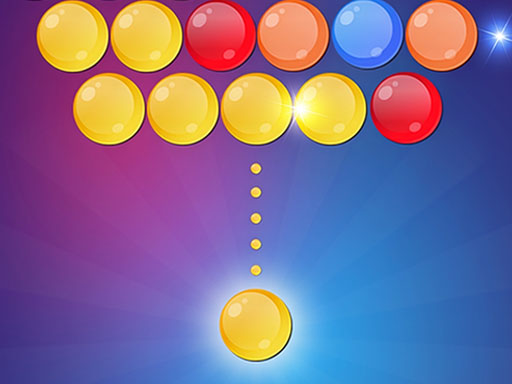
You fire bubbles from a cannon at the bottom of the screen; the guide line shows where the shot will travel, including bounces off the side walls. A bubble that lands touching two or more of its own colour pops the whole connected group — three or more. Any bubbles that were hanging from the popped group and no longer connect to the ceiling fall as well, for bonus points. The field creeps downward as you play, and the game ends when bubbles cross the bottom line.
That second mechanic — the drop — is where all the scoring lives. A pop removes three bubbles; a well-chosen pop can drop twenty. Always ask what is hanging under the cluster before you fire.
Hunt support bubbles, not colours
Scan the cluster for the bubbles doing structural work: the ones that connect a large hanging section to the ceiling. Pop one of those — even a small group — and the whole unsupported section below falls at once. The habit to build is reading the cluster bottom-up: find the heavy mass you want gone, then find the thinnest strand holding it up. That strand is your target, even if it is a colour you were not planning to shoot.
The corollary: never fire at a two-bubble group wedged high in the ceiling unless it also does structural work. Popping three bubbles from the middle of the field is a tidying move; dropping a section is a scoring move — and the ceiling only respects the second one.
Bank shots are how the board is really cleared
Straight shots reach only what the cluster shows you. Bank shots — fired at the side wall so they reflect into the gap — reach what it hides. Overhangs, pockets and the far corners are all bank-shot territory, and the aim line makes the angles readable: put the guide line on the wall and watch where it bends. Two techniques cover most cases:
- The steep bounce for corners. Fire at a sharp angle so the bubble arrives almost vertically into a pocket under an overhang.
- The shallow bounce for tunnels. A long, flat reflection travels deep between two sections of the cluster — the standard way to reach a support bubble tucked behind a lip.
Colour discipline and the ceiling
The clock in Bubble Shooter is the creeping ceiling, and every wasted shot buys it another step. Wasted shots come in two flavours: the bubble that lands without matching anything, and the bubble fired without a plan. The second is the expensive one. Before firing, know which cluster you are working on and what a good result looks like — a pop, a drop, or at worst a placement that sets up the next shot. If the current bubble helps nothing, bank it into a spot where it at least keeps a future match alive.
Priorities near the bottom of the screen change too. When the field is low, take the highest-value pop you can see immediately rather than setting up something clever two shots away — there may not be two shots. When the field is comfortable, spend the time working the ceiling: clearing rows high up slows everything that follows.
Three habits worth building
- Read the cluster bottom-up before every shot: what is hanging, what holds it, where the thinnest strand is.
- Use the guide line to rehearse bank shots — the wall is a tool, not a boundary.
- Never fire without a named target. "Somewhere up there" is how ceilings win.
Load up Bubble Shooter and put the habits to work. For the faster half of the arcade, Snake strategy covers route planning on a closed board; for the calmer kind of browser break, browse the puzzle games or the arcade games guide.